Sunday, January 11, 2009

Early thunder on Saturday

The weekend could start off wet for many of us. Futuretrack_01022009

Low pressure in the upper atmosphere will push across Texas early Saturday. The first thunderstorms of the New Year will begin to develop after midnight. By daybreak Saturday there could be rumbling in the sky over most of the area ....an early wake-up call!

There is a slight risk some of the storms could produce large hail and damaging winds. Track the storms online with MegaDoppler 13, the most powerful radar in Houston.

Most of the moisture will move east, out of the Houston area by Saturday afternoon. At that time we could see a little clearing.

A few more showers could develop when the cool front arrives early Sunday. There won't be as much moisture in the air when the front arrives, so I'm not expecting as much rain. You'll notice the chance of rain is a lot lower on Sunday.

The north wind will blow much colder air this way on Monday. The kids will need coats when they head back to school!

Warm weekend, colder next week

Well, I slept fine last night. Thing is, I wasn't expecting it to be a silent night.

The upper low moved through southeast Texas very quickly, producing only a smattering of rain early this morning. I mentioned during the news on Friday and here on the Houston Weather Blog that if this upper low moves fast enough we could see some clearing behind it. The rest of the day should be sunny because of sinking air currents on the backside of the disturbance.

A cool front arrives on Sunday and there's still a slight chance of a shower along the front. Moisture will be limited so the chance is pretty low. Temperatures will be a little cooler and the humidity will drop as well. Sunday looks like it could be a good day for outdoor fun (or work, if you still need to take down your holiday lights.)

The real cold arrives just as the kids are heading back to school after the long holiday break. We'll be in the 40s all day Monday with gusty north winds. Moisture over-running the cold air will bring in thick clouds and showers. It's going to be a cold, wet day.

Hurricane Gustav's +200 mph winds

Www_g_sat_full_2When Hurricane Gustav passed over Cuba last August, the anemometer there was blown away by a 212 mph wind gust. If the data verifies it would be the fastest wind speed ever recorded in a hurricane!

Jeff Masters reports on his "Wunder Blog" that this could also be "the second highest wind gust ever measured on the surface of the planet." The current record is 231 mph recorded in April 10, 1934 at the Mount Washington weather observatory in New Hampshire.

The 212 mph wind gust in Gustav was recorded not along the coast, but in Paso Real de San Diego, about 15 miles inland. While the mountains in western Cuba probably helped funnel and accelerate the wind. Jeff explains, "When hurricanes make landfall, the intense thunderstorm cells that comprise the eyewall sometimes collapse suddenly, sending a downward cascade of intense winds to the surface."

We've always known the strongest, most destructive winds in a hurricane occur within the eyewall. That's what hit Houston during Hurricane Ike. "Hotspots" on the radar within the eyewall could signal a more intense downburst within the band of fierce winds.

Hurricane Ike seminar this Friday

There's still time to register for the Weather Museum's Hurricane Ike Seminar.

The conference will focus on Ike and the lessons we learned from that storm. Presentations start at 8 AM on the University of St. Thomas campus. I'll be participating in a media panel discussion after lunch. The conference is open to the general public. Registration fees are $25, only $10 for students.

For more information contact Benjamin Maloney at the Weather Research Center. His phone number is 713-529-3076.

ABC13 viewers capture the sunset

During 13 Eyewitness News early Wednesday evening, we issued a special "sunset alert." We knew the high-level, wispy cirrus clouds would provide a beautiful view as the sun dropped below the horizon. A perfect ending to a perfect day.

I asked you to grab your camera and take a few photos of the sunset...and you did! Thanks to everyone who emailed their "skyscapes" to ABC13. Here are some of the many photos sent to our inbox:

Libby_youngblood_in_porter
Libby Youngblood saw this view over Porter around 6:00 PM.

weatherblog.abc13.com

Jill_paxson_in_cypress
Jill Paxson found the waxing moon shining through the thin veil of clouds near Cypress.

weatherblog.abc13.com

Jackie_redmond_in_magnolia
Not every sunset is orange. Jackie Redmond captured the slate gray and blue sky over Magnolia.

weatherblog.abc13.com

Nicki_evans_in_anahuac
I love this picture of the clouds over Trinity Bay photographed near Anahuac by Nicki Evans.

weatherblog.abc13.com

Cynthia_canales_in_blessing
There weren't as many clouds in the sky over Blessing. But the view to the west was still very pretty, photographed here by Cynthia Canales.

weatherblog.abc13.com

Chris_kattner_in_conroe
The trees stand out in silhouette in this picture taken by Chris Kattner near Conroe.

weatherblog.abc13.com

Bill_roper_in_houston
Check out this picture from Bill Roper. Awesome!

When you capture an incredible view of the sky, send it to us!

It's 120° colder in Alaska!

Alaska_coldWhile we've been enjoying sunny, mild weather the last few days it has been unusually cold in the northern part of the continent. Temperatures have been -40 to -60 degrees below zero across interior Alaska and western Canada while we've been in the 60s and 70s.

weatherblog.abc13.com

Web_saturday_temps A little piece of that cold air will blow into southeast Texas this weekend. Our high temps will be in the upper 50s, which is about twenty degrees colder than it was on Thursday and Friday. And with a strong northwest wind, it will feel even colder.

Temperatures will climb a little next week. But I'm expecting another piece of cold air will drop south toward the end of next week, perhaps some of the coldest air of the season for us and for much of the country.

Time to dig out the coats again and stock up on firewood!

Saturday, January 10, 2009

It's beginning to look a lot like ...

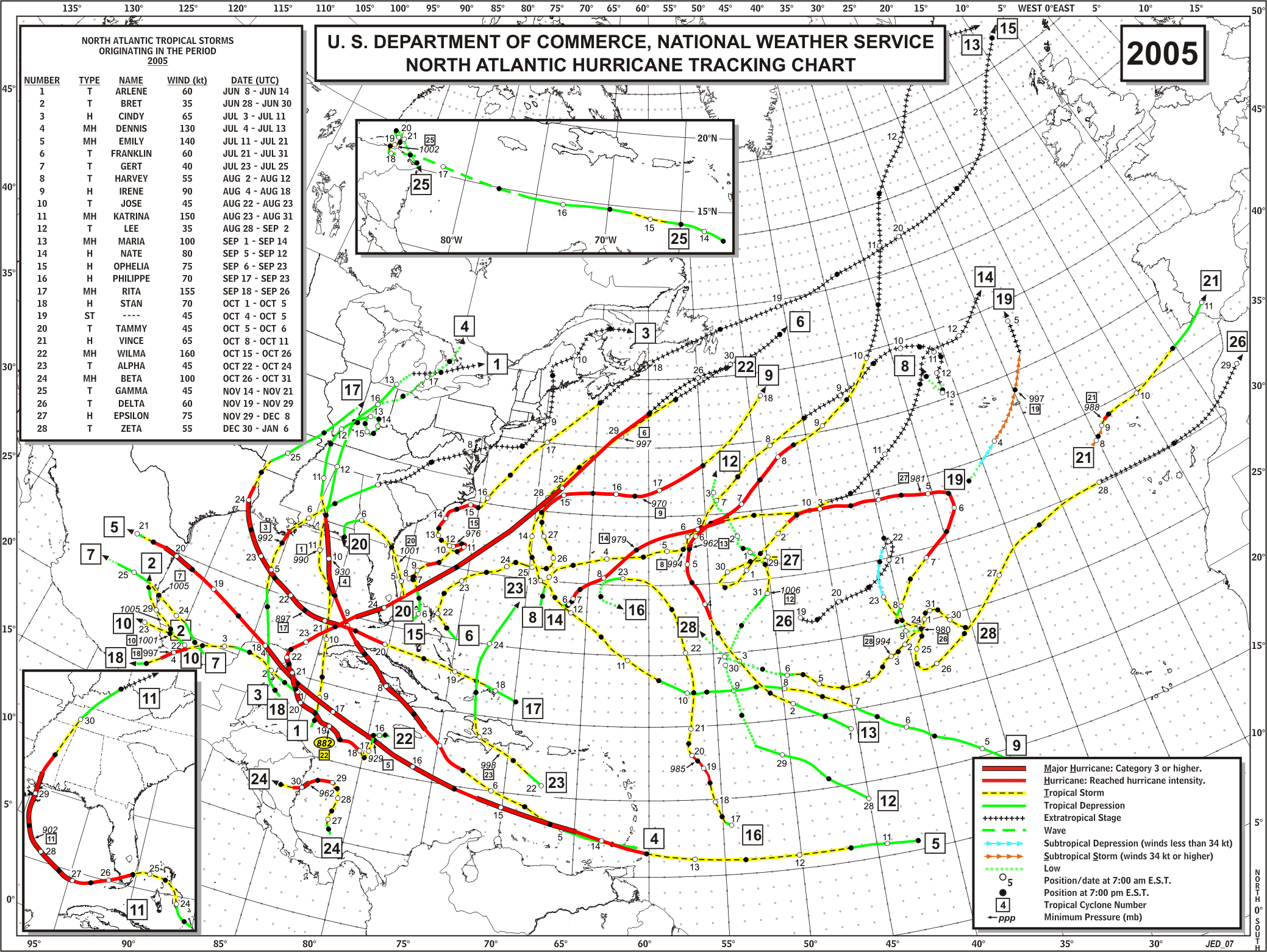
... well, not quite 2005. We're fortunately already falling behind that pace -- by now there had been the "E" storm as well as two major (Category 3+) hurricane landfalls, Emily in Mexico on this date and Dennis the week before in Cuba and the U.S -- but the tropical atmosphere is otherwise about as stoked as it ever gets at this point in the season.

On the satellite image (click on it for a much larger version), there is, at the time of this posting:

(1) Yet another well-organized low emerging off the coast of Africa.

(2) Bertha, still a tropical storm and continuing to set July records.

(3) A low spinning offshore just northeast of Jacksonville, Florida.

(4) A disturbance in the eastern Caribbean which keeps waxing and waning but can't yet be written off as it heads in the general direction of the Yucatan and Gulf of Mexico.

(5) A disturbance bringing locally heavy rain to Central America.

And, in the eastern Pacific:

(6) Tropical Storm Fausto.

(7) Hurricane Elida.


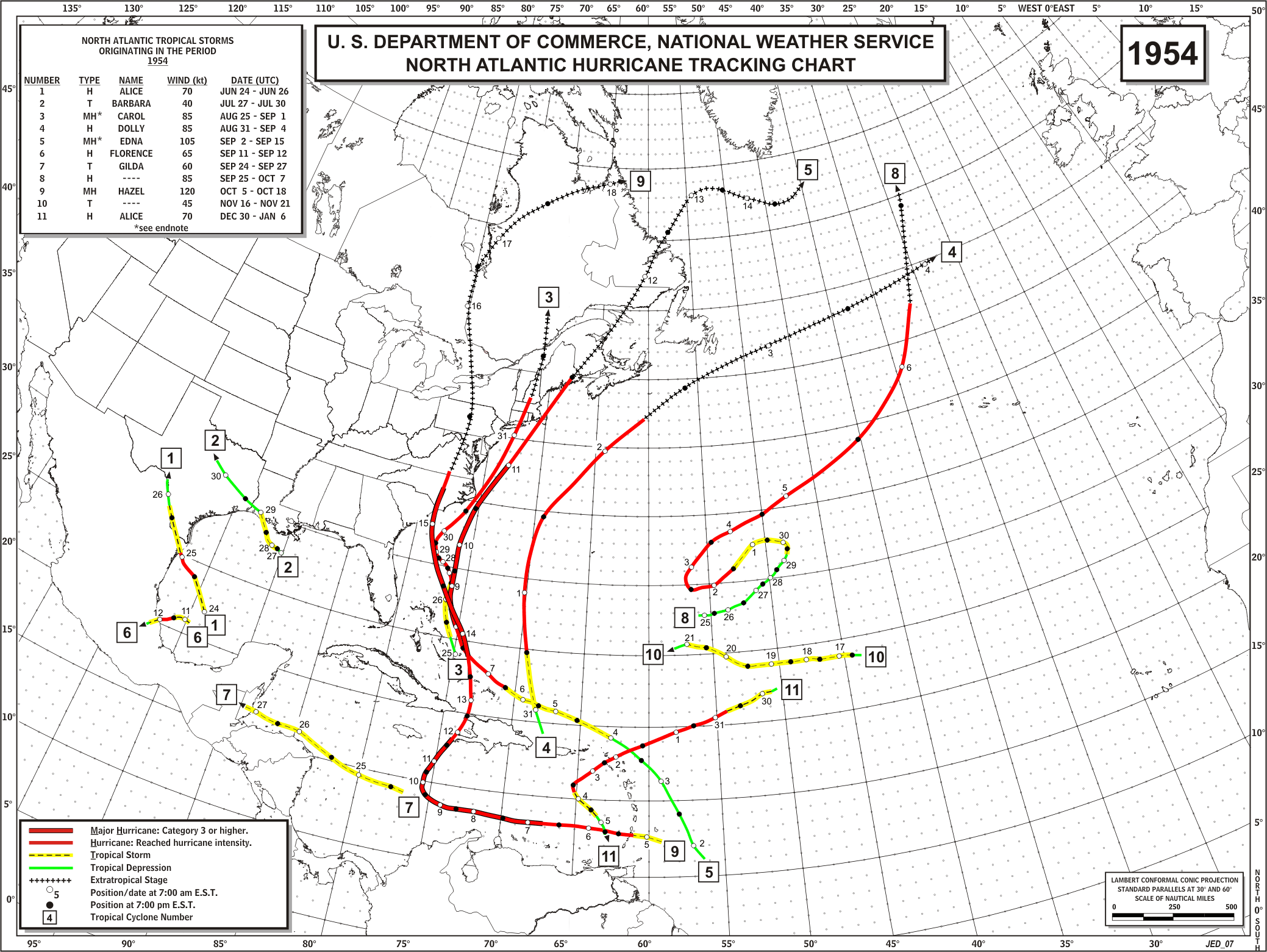
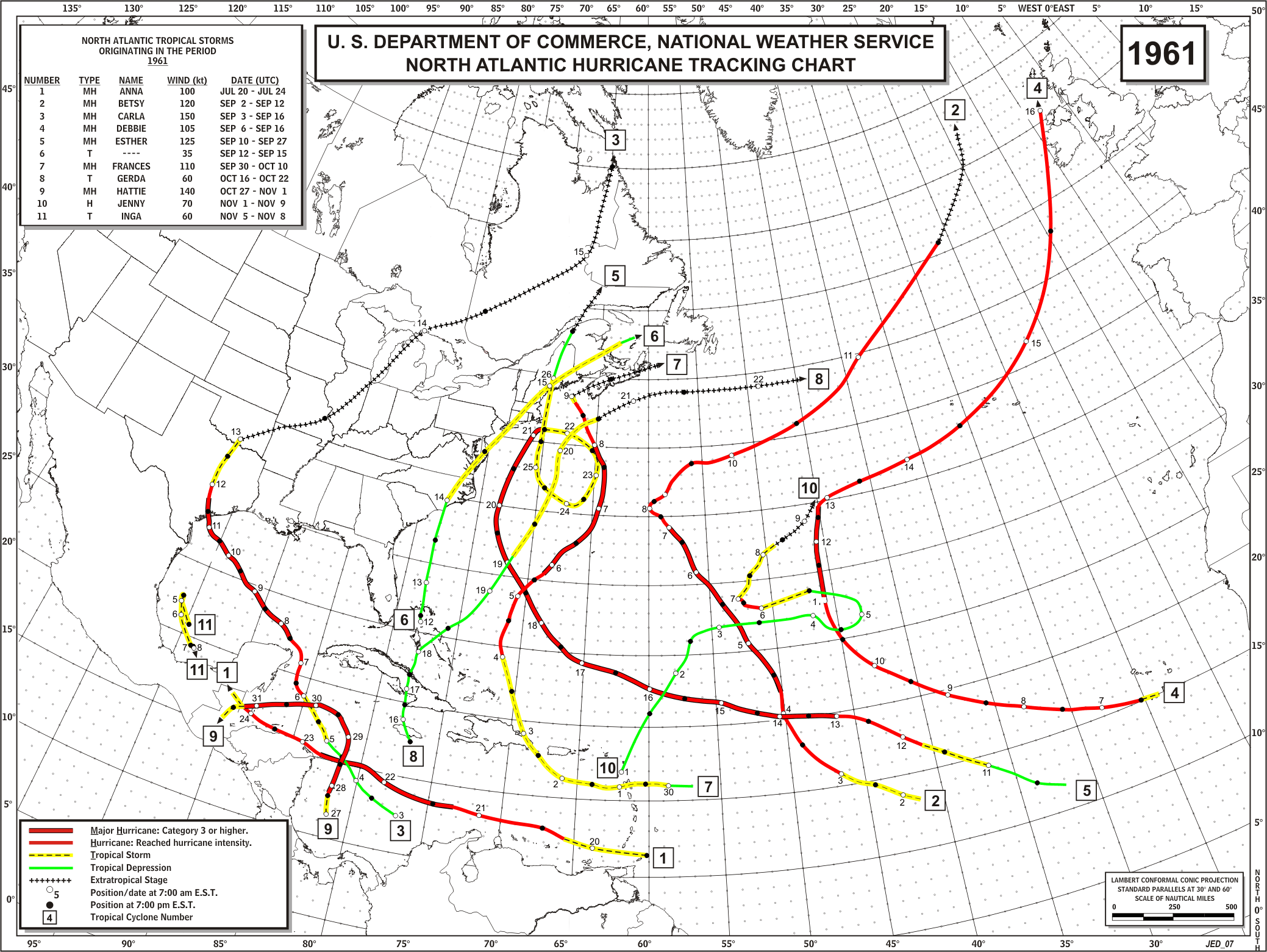
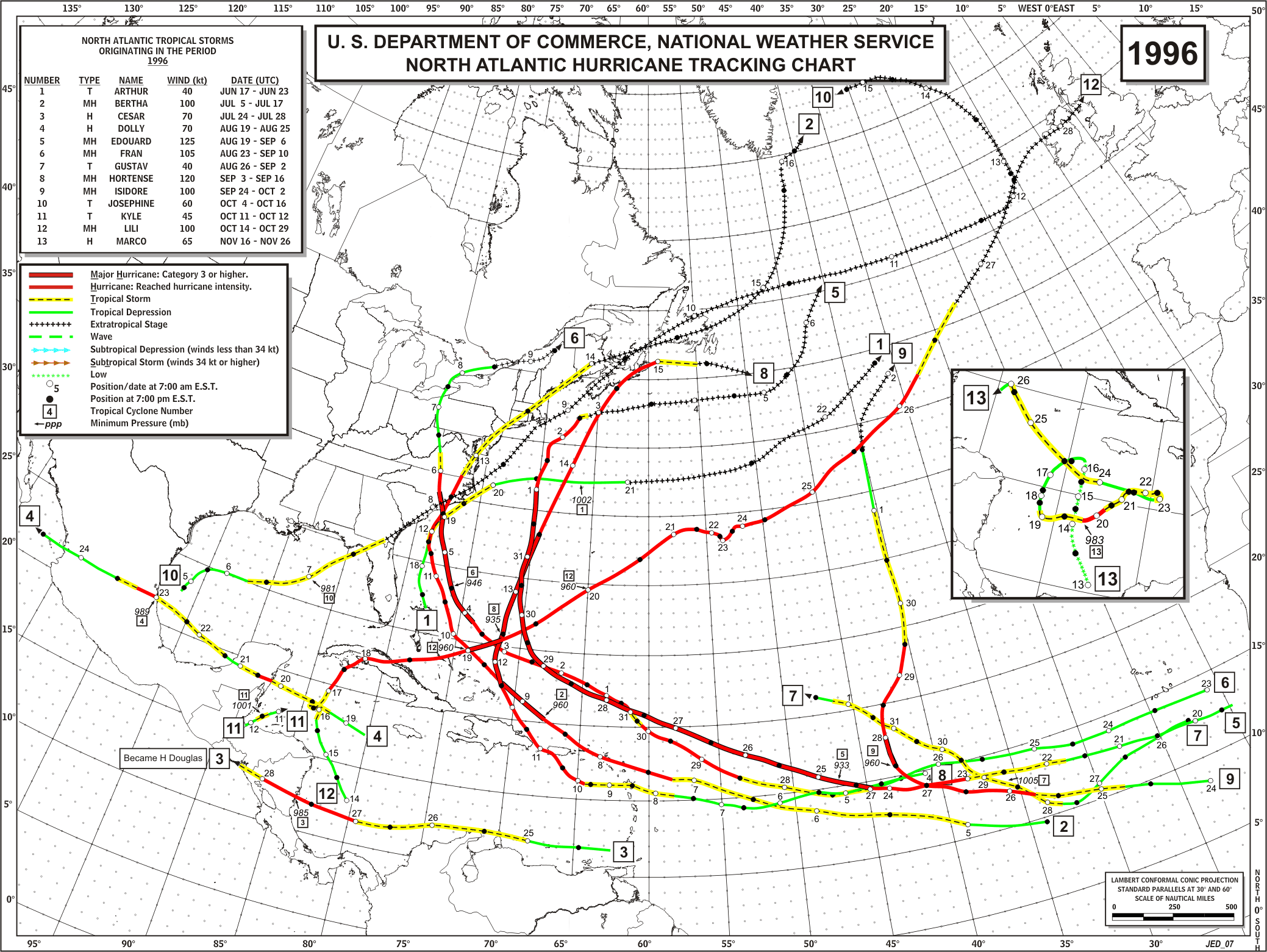
Based on historical data courtesy of Dr. Phil Klotzbach (of the CSU team with Dr. Bill Gray), since 1950 only five years in addition to 2008 have had a hurricane form in the tropical Atlantic east of 75W and south of 23.5N prior to August: 1954, 1960, 1961, 1996 and 2005.

Only four other years had a major hurricane form there prior to August: 1926, 1961, 1996, and 2005.

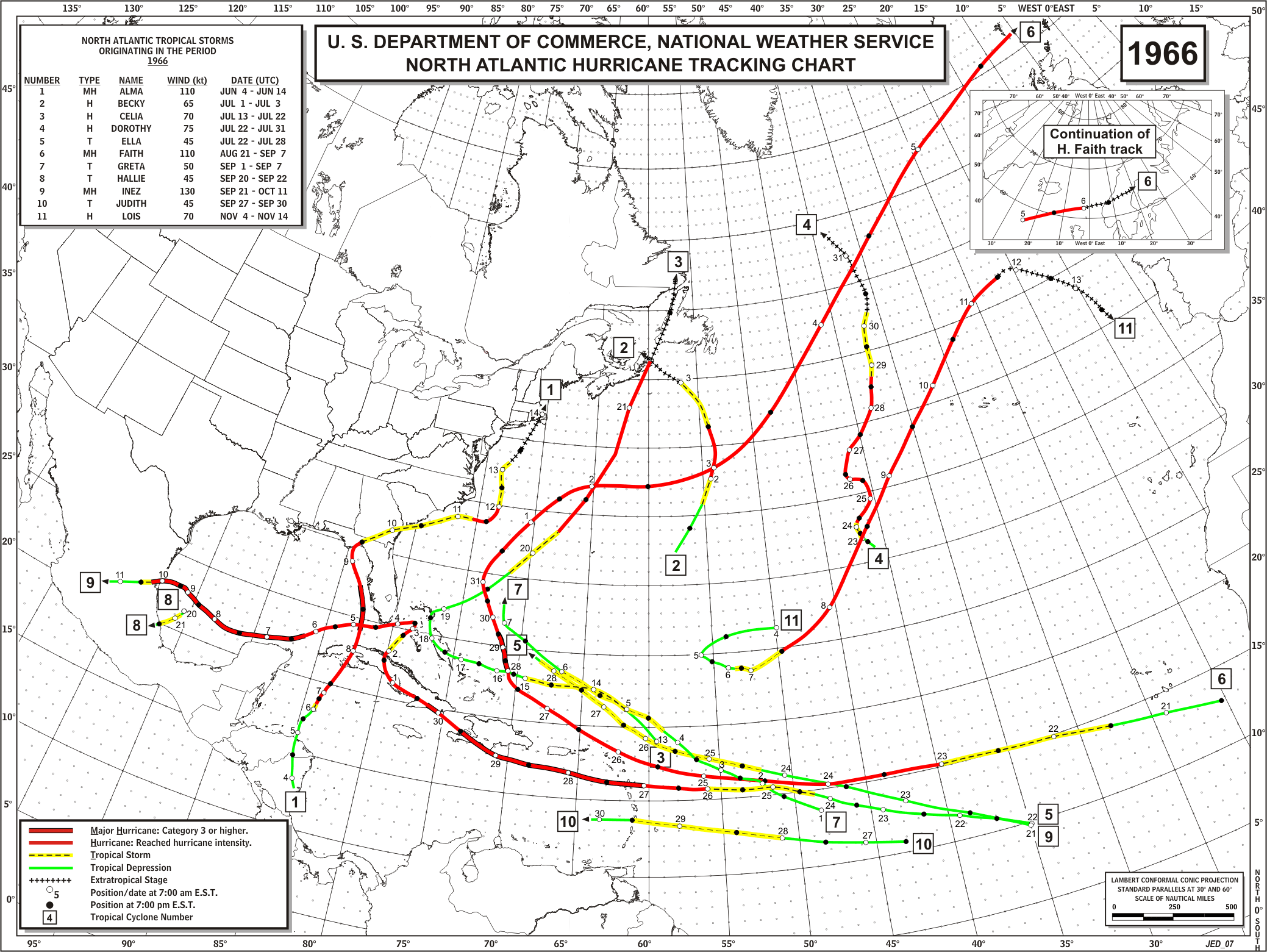
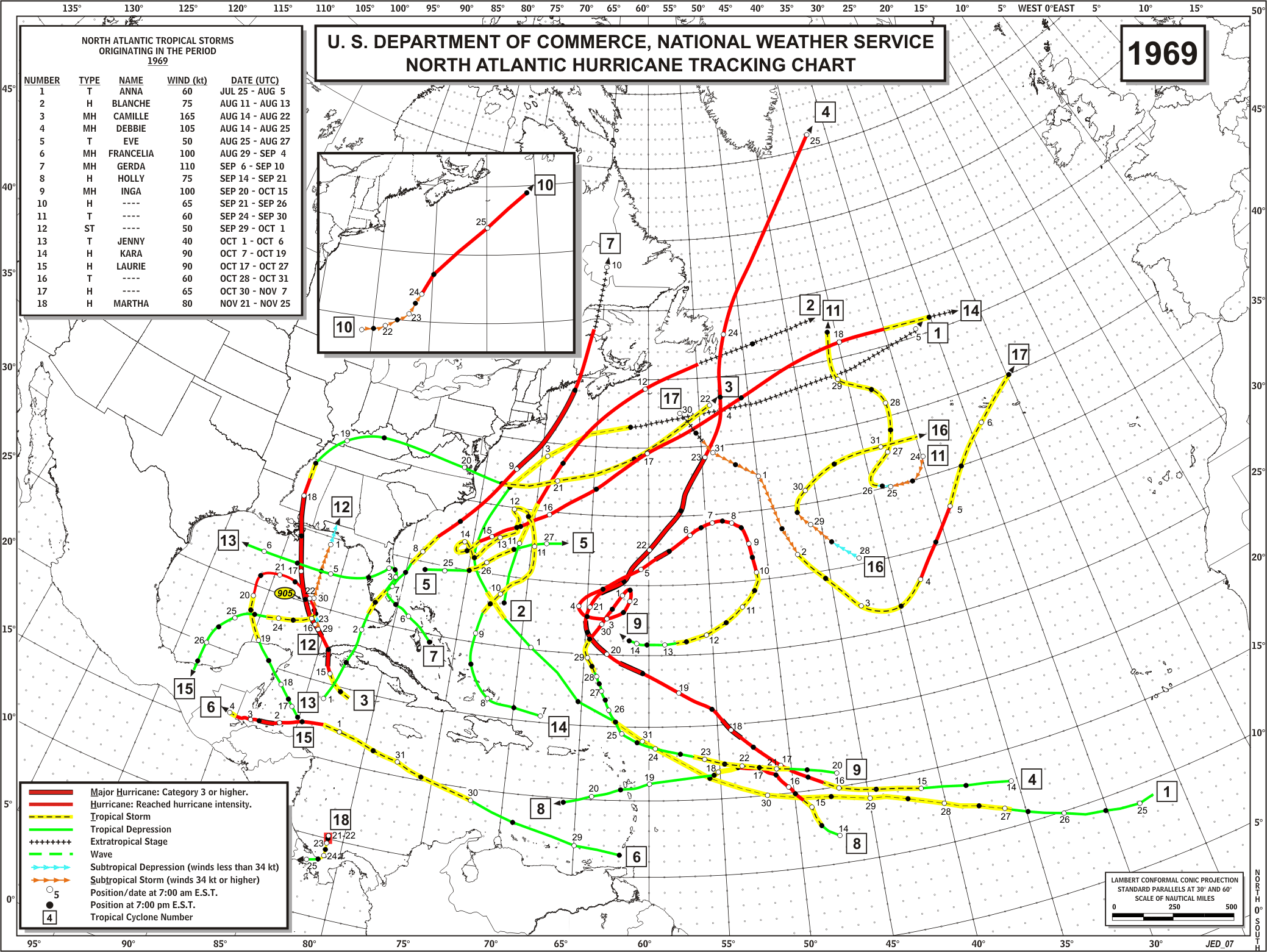
Other years with a notable amount of named storm days (NSD) in that area besides a few of the years already cited include 1966 and 1969.

All of the years listed above went on to have at least one very significant event:

1926 - The Great Miami Hurricane.
1954 - Three major hurricanes hit the East Coast of the U.S., including the legendary Hazel.
1960 - Hurricane Donna, which whacked the coast all the way from Florida to the Northeast.
1961 - Carla, a gigantic Category 4 that hit Texas.
1966 - Inez, a nasty hurricane which swept across the northern Caribbean islands, brushed South Florida, and ended up in Mexico.
1969 - Camille.
1996 - Fran, which made landfall in North Carolina shortly after that year's Bertha.
2005 - Well, we all know what happened that year.


Let's hope that the current situation changes and at the end of the season we look back and see that although July was inauspicious, the atmosphere settled down and/or the configuration of steering currents kept any significant tropical cyclones away from land ... but at the moment the character of the tropical atmosphere (the amount of convection, instability, spin, etc.) is much different than it was in July of the past two years, and is reminiscent of July during years past that did not have a good outcome.


UPDATE 3PM SATURDAY JULY 19

Still active ...

In the Pacific, Elida moved into stable air and weakened, while Fausto strengthened into a hurricane and is sending waves to the Mexican coast; the western Caribbean disturbance crossed over Central America, where it produced locally heavy rain, and has the potential to become a tropical cyclone in the eastern Pacific.

In the Atlantic, the disturbance which was northeast of Jacksonville, Florida is now closer to Jacksonville, North Carolina and has developed into Tropical Storm Cristobal as it skirts the coast.


The tropical wave in the eastern and now central Caribbean still bears watching and is still headed toward the Yucatan and Gulf of Mexico. Kingston, Jamaica today has had squalls with heavy rain and sustained winds briefly as high as 31 mph.


Bertha is still a tropical cyclone; in fact it reintensified into a hurricane.

The low in the extreme eastern Atlantic has fizzled but there's another strong disturbance over Africa that will emerge off the coast in a couple of days, and we're now heading toward the time of the year when the "Cape Verde season" typically ramps up (it got off to an early start this year with Bertha).

Flooding update

MIDWEST U.S.

Still no answer to the question of when the bouts of heavy rain in this region will end. We're back in a pattern which will bring occasional rounds of wet thunderstorms during the next few days which could lead to localized flash flooding, and there's an all-too-familiar sight on the satellite and radar images early this Friday morning. There had been a break for awhile, which is a good thing because it allowed most of the rivers to recede.


[Radar image source: GRLevelX]


MEXICO

A couple of weeks ago I wrote about a persistent flow of deep tropical moisture into southernmost Texas and northeast Mexico. The most extreme amounts fell south of the border, and it would have been surprising if serious flooding did not occur there, yet I was unable to find any info about it and thus was hopeful that a disaster did not occur. It turns out that, alas, one did, even though it has received scant media attention in the U.S.

I first saw an article online about it in a publication from Thailand. I emailed Jeral Estupinan, who used to be a colleague at TWC and now is the SOO (Science and Operations Officer) at the National Weather Service Forecast Office in Brownsville, Texas. He confirmed that indeed it has been very bad for many communities in the state of Tamaulipas, and sent me a link to a video of the flooding. Our thoughts are with the folks recovering there.

Rainfall for seven days ending July 10, 2008 in millimeters; 300 mm = approximately 1 foot


ADDENDUM FRIDAY 4PM EDT

Speaking of heavy rainfall and flooding, there are reports that up to 44" fell in 24 hours in southern Tawain from Tropical Storm Kalmaegi.

As incredible an amount of rainfall as that is, it's not the world record for 24 hours, which is 72" on Reunion Island, east of Madagascar in the Indian Ocean, in 1966.

The U.S. 24-hour rainfall record occurred in Alvin, Texas in July 1979, associated with Tropical Storm Claudette. Different sources give different values, but the one which is generally most accepted (per this NWS statement issued after Allison in 2001) is 43".

Spinning

[updates follow original entry; latest as of Sunday evening]


[Radar images: GRLevelX]


Tropical Storm Cristobal continues spinning with its center just offshore, but it has not become any better organized since Saturday afternoon, in fact winds on the North Carolina and South Carolina coast at this hour (midnight) are quite light. Cristobal will brush the coast on Sunday with only minor impacts expected on land (locally heavy showers and breezy weather, but watch out for rip currents).

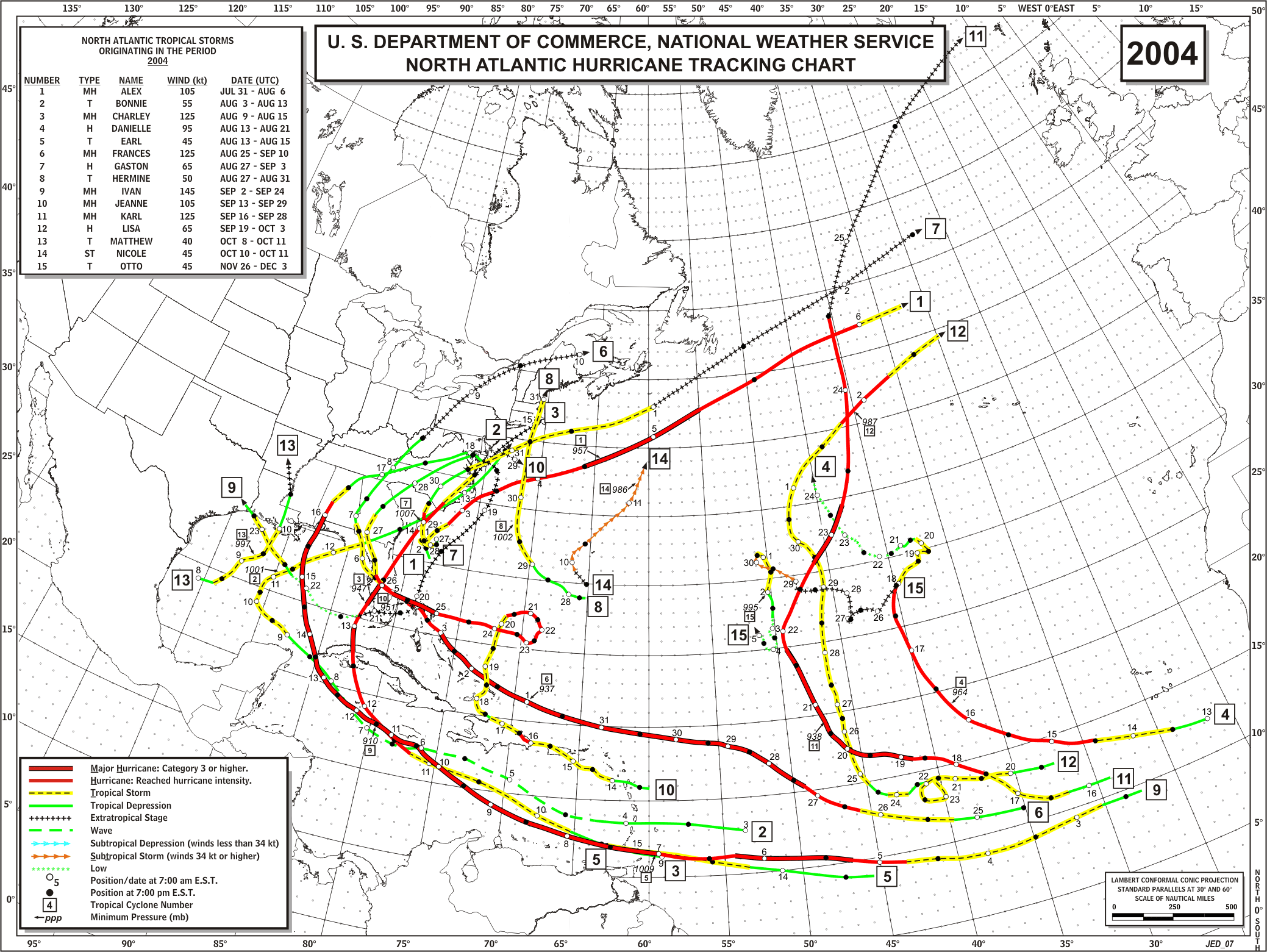
Cristobal, however, brings back memories of Alex in 2004, which was in a similar position, sliding parallel to the coast and not expected to be as bad as it turned out to be. The storm suddenly became a Category 2 hurricane, its center hooked close to shore, its western eyewall raked the Outer Banks, and Ocracoke Island was particularly hard hit. I hope I don't wake up in the morning and see that something similar is starting to happen!


Meanwhile, yet another cluster of big thunderstorms is hitting Iowa.


And not only does it have a spectacular signature on radar (much more impressive than that of the tropical storm), it resembles the hurricane symbol!


The middle of the system was even rotating, and the bowed line of storms (known as a bow echo) produced wind damage.

Lastly, the next disturbance over Africa, which in my Saturday afternoon update to my previous entry on the active tropics I mentioned was the next potential Cape Verde-type development, looks like it'll head into the tropical Atlantic during the next couple of days as a spinning low pressure system, not just a tropical wave. At least temporarily it too has an impressive signature on the imagery -- looking like something typically more likely to be seen there in mid-August than mid-July ...


UPDATE 1PM EDT SUNDAY JULY 20

Well, I could have rested easy. Cristobal has behaved itself, having not significantly strengthened.

Here's more on the Cristobal - Alex comparison I referenced above.

This NASA MODIS image from the afternoon of August 2, 2004 shows Tropical Storm Alex. It's a little hard to see the boundary between ocean and land, but the center of the storm is a short distance off the coast of South Carolina.


Tropical Storm Cristobal yesterday (Saturday) afternoon, looking similar in structure, with its center also just offshore of the South Carolina coast:


Now, Alex the following day!


Compare that, an intensifying hurricane, with Cristobal this Sunday morning, with much of its inner core devoid of deep convection (rain and thunderstorms), and its center within an "exposed" low-level swirl of clouds and shallow showers:


Happiness for coastal residents and visitors is dry, sinking air, shown by the black and dark red shades, swooping into the storm and inhibiting its development!


So the effects on the NC coast will be much more minor than from Alex -- just some brisk winds and locally heavy showes, not the kind of storm surge which inundated Ocracoke in 2004.

Even if the storm continues to hold steady in intensity or only increases a little, though, there will be one life-threatening effect: rip currents as a result of waves generated by the storm. Waves in general tend to be feistier on the Outer Banks than many other places, and with this being a weekend in the midst of the peak of the summer beach season, and a tropical storm coming through, be careful in the water!

Meanwhile ...


DOLLY

In the Caribbean, aircraft reconnaissance found that the tropical wave became a spinning "closed circulation" (the center of which is where I've put a circle below); deep convection continues to be very persistent; and the National Hurricane Center has named the system Tropical Storm Dolly.

Skipping over the tropical depression stage can happen when a tropical wave is very vigorous, with tropical storm force winds, just awaiting the flow of surface winds to become a complete circle rather than merely bending like a wave.

Dolly will head across the Yucatan, which will inhibit development, and then move over the southwestern Gulf of Mexico, where intensification is likely, with a midweek second landfall expected somewhere on the coast of Mexico or South Texas. The latest TWC forecast "cone of uncertainty" for the track of the center of circulation can be found here.


SUNDAY EVENING UPDATE

Although convection is flaring more than it has in awhile with Cristobal, it's on the south and east side of the center, which has now passed the Outer Banks and is starting to move away from the coast.

A statement issued by Hyde County emergency management included this: "As everyone in Hyde already knows, this was total non-event, even in Ocracoke. We barely had even a few sprinkles and no wind to speak of and not a single squall."

That's what we like to hear!

Dolly, though, continues to organize ... and in regard to that disturbance I mentioned over Africa, this isn't something you see every day in the National Hurricane Center's tropical weather outlook:

A VIGOROUS AND WELL-DEFINED TROPICAL WAVE IS LOCATED OVER WESTERN AFRICA A FEW HUNDRED MILES EAST OF DAKAR SENEGAL. THIS SYSTEM HAS THE POTENTIAL TO BECOME A TROPICAL CYCLONE VERY QUICKLY AFTER IT EMERGES INTO THE EASTERN ATLANTIC ON TUESDAY.

Spinning onshore

[updates follow original entry; latest as of 7:30 pm EDT Wednesday]


Finally able to catch a breath and post an entry in the midst of getting busy with Dolly; after a plateau on Monday, the storm's spin increased to hurricane intensity on Tuesday and is on a beeline toward the coast of South Texas and extreme northern Mexico.


This is about as wild-looking a satellite image as you're going to see of a weak tropical storm, as Dolly was Monday evening.


Although it looks like the storm was massive in size, much of what you see was just innocuous clouds.


Twenty-four hours later, and the satellite image is still a bit misleading.


Dolly is stronger now, having become a hurricane, and it's not nearly as small in size as Humberto was when it was in the western Gulf last year.

However, while there are some thunderstorms hundreds of miles north and northeast of the center, all of the strong winds directly associated with the hurricane are confined to the inner core of the hurricane, represented by the darkest reds on the satellite image above to the southeast of Brownsville and the swirl of colors on the radar image (which is much different in character than the appearance of Cristobal on radar while approaching North Carolina a few days ago).


The center of the hurricane is headed toward a landfall on Wednesday not far from the U.S/Mexico border. The exact time will depend on the degree to which Dolly continues slowing down, but regardless conditions will deteriorate overnight as that stuff on radar reaches the coast, well ahead of the arrival of the center.

We'll have to keep a close eye on the intensity overnight. The latest aircraft recon measured a central pressure of 982 millibars, or exactly 29 inches of mercury, but did not find winds as strong as sometimes is the case with a pressure that low. We'll have to see whether the winds "catch up," although fortunately the hurricane is close enough to the coast that time will run out for strengthening before too much longer.

Even if the hurricane continues intensifying, barring something shocking happening its winds will still be a far cry from those of hurricanes such as Category 5 Andrew in 1992 or Category 4 Charley in 2004, both of which hit South Florida, and both of which produced severe direct structural damage, destroying many buildings.

Nevertheless, although Brownsville has been brushed in recent years, the center of a tropical storm or hurricane hasn't passed within 25 miles of the city since Allen in 1980, and if Dolly's center doesn't do that it's not gonna miss by much. Thus, folks in the greater Brownsville area should be prepared for stronger winds than they usually see, and those winds will be capable of downing trees, causing power outages, etc.

The coastal surge won't be anything like that of Katrina, but expect several feet of water level rise along with high surf on top of that.

Then there's the rainfall, the magnitude of which won't be dependent on whether the hurricane's wind velocity increases. After landfall Dolly will be moving slowly, leading to a persistence of torrential downpours. In extreme southern Texas, although the wet system a couple of weeks ago alleviated the drought, more moisture is needed, but not so much so quickly that flooding or flash flooding occurs.

The Brownsville office of the National Weather Service noted in one of their analyses on Tuesdsay:

WORTH MENTIONING THAT WITH THE INCREASING CONFIDENCE IN A WIDESPREAD HEAVY RAIN EVENT... BROWNSVILLE HARLINGEN AND MCALLEN ARE IN JEOPARDY OF SHATTERING ALL TIME JULY TOTALS. THE FOLLOWING ARE CURRENT TOTALS AND THE VALUES NEEDED TO BREAK THE ALL TIME RECORD:

BROWNSVILLE.....6.22 SO FAR 3.22 NEEDED TO BREAK JULY RECORD
HARLINGEN.......6.18 SO FAR 2.47 NEEDED TO BREAK JULY RECORD
MCALLEN/MILLER..4.97 SO FAR 5.01 NEEDED TO BREAK JULY RECORD

And the prospect of another deluge is decidely unwelcome in the Mexico state of Tamaulipas, just south of the border, where the flood disaster occurred earlier this month.


UPDATE 7 AM EDT WEDNESDAY JULY 23

Good news and bad news this morning. The good news is that Dolly's intensity didn't do anything drastic overnight and it's rapidly running out of time. The bad news is that the hurricane didn't weaken either, in fact it continued to get better organized and strengthen slowly.

The inner core of the hurricane is pushing onshore, and the eyewall, which contains the strongest winds, is not far offshore. That eyewall has had a particularly dramatic appearance on radar, with its curved line segments rotating around the center like spokes on a wheel.


UPDATE 9:45 AM EDT

The central pressure has dropped to at least 967 millibars, with 964 "extrapolated" from about 10,000 feet.

The significance of all that is that a pressure in the mid 960s is typical of a hurricane well into the Category 2 range, even getting close to Category 3. In this case the aircraft wind measurements have been lagging behind what one might expect given the pressure, but the steadily dropping pressure and much more well-organized appearance on satellite imagery indicate that the hurricane continues to crank up.

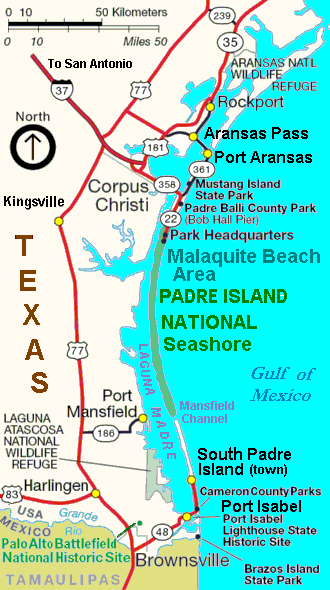
The increased wind means that not only will trees and power lines come down (already there are outages being reported), but direct structural damage will also occur, especiallly to less sturdy buildings. Jim Cantore, reporting from South Padre Island, just showed how the water level has receded where he is, but that's because there's temporarily an offshore wind at that location -- the surge is still coming.

As I noted above it's been a long time since this area has had a direct hit by a strong tropical cyclone, and with the western eyewall within 10 miles of the coast it's time to batten down the hatches ... and with the slow movement of the hurricane, the roughest weather is going to take quite awhile to work its way through ...


UPDATE 12:15PM EDT WEDNESDAY

The National Hurricane Center did bump the intensity up to Category 2 in their latest advisory. The center is moving painfully slowly, so it hasn't made landfall yet, and it has also wobbled a bit north.

As I wrote about during Hurricane Dean last year, sometimes little wobbles matter, and that's the case today, for example if the eyewall (which contains the strongest winds) were to miss Brownsville and hit mainly unpopulated areas to the northeast. Also, a northward jog would reduce the surge on South Padre Island where Jim Cantore is and instead bring it onto the National Seashore. The steering currents are weak at the moment so it's a matter of tracking the center closely minute by minute.

Even with the center wobbling a little farther north, we're starting to get reports like these in from around the region:

1104 AM SOUTH PADRE ISLAND
ALL POWER OUT TO ISLAND. DAMAGE TO CONDOS.

1104 AM PORT ISABEL
POWER LINES DOWN. SCATTERED FLOODING.

1104 AM HARLINGEN
POWER POLES BLOWN DOWN ON BUILDINGS.

1104 AM BROWNSVILLE
POWER LINES DOWN. SCATTERED FLOODING. DEBRIS ON ROADWAYS.


UPDATE 6:30 PM EDT WED

Well, it's been quite a long day for folks in extreme southern Texas, as Dolly intensified and made landfall as a borderline Category 2, and has been slooowly moving across the region, and it's not close to being over yet.

Here's a 3-D and cross-section look at the eye and eyewall around the time of landfall, followed by a conventional radar image shortly prior to landfall of the southwest eyewall which erupted over South Padre Island.

Source of images: GRLevelX


Tropical cyclones get energy from the warm water over which they form, and weaken upon moving inland, some at different rates than others. More so than with some, Dolly is still having quite an impact hours after landfall, because it's moving slowly; it was a solid hurricane at landfall, near peak intensity; it's not small in size; and its landfall on the mainland was awhile after its official landfall on a skinny barrier island, and that mainland is flat and low-lying.

In fact, at this hour (5pm CDT), more than three hours after landfall, the center of Dolly is only about 20 miles from the landfall point on the barrier island and only 10 miles inland from Laguna Madre the bay separating the barrier island from the mainland.

The southwest eyewall which flared up while over South Padre Island, from where TWC's Jim Cantore and Julie Martin have been reporting, is still very potent for both wind and rain as can be seen on the recent radar image below, and there are communities north of Brownsville in its path which are still getting hit very hard by both. As is the case with tornadoes, it is likely that it'll take awhile for complete information to be received on what the impacts have been.

In regard to weather observations, we are getting none from Harlingen, because there appears to have been an instrument failure. This was the last ob, from 2:19 pm EDT with the wind "MMMM" (direction and speed both missing):

HRL SP 1919 AO2A 73/73/MMMM/923/ RAEMM PRESFR $ PCPN 0070=

But we have started getting reports of flooding there:

...SEVERE FLOODING REPORTED IN HARLINGEN...

HEAVY AND PERSISTENT SHOWERS...ASSOCIATED WITH THE EYE OF WEAKENING HURRICANE DOLLY...ARE CAUSING MAJOR FLOODING IN THE CITY OF HARLINGEN THIS EVENING.

A TEXAS STATE OFFICIAL REPORTED TWO FEET OF WATER IN PORTIONS OF DOWNTOWN HARLINGEN...WITH WATER IN HOMES IN THE JACKSON STREET AREA. THE HARLINGEN POLICE DEPARTMENT REPORTED FLOODING ON POLK... TAYLOR...PIERCE...FILMORE...AND COMMERCE.

A long day, and it's gonna be a long night. Eventually the wind will start abating below levels capable of causing widespread problems, but the locally heavy rainfall and a flood threat will continue into Thursday, including in areas just south of the border which escaped the strongest winds today.


UPDATE 7:30 PM EDT WED

During the past hour, there was another weird radar image produced by Dolly. "Spokes" in the eye are not uncommon as observed on visible satellite imagery and sometimes on radar, but this was a particularly distinct, straight-line one bisecting the eye as it spun around:


Meanwhile, I looked at the historical data for some perspective on other U.S. hurricanes that had landfall pressures of millibars in the 960s or so (approximately 28 1/2 inches of mercury). In general, the lower the central pressure of a tropical cyclone, the stronger its winds are.

Although it's possible this will be changed in the official postseason report, the central pressure listed in the NHC advisory prior to and shortly after landfall of Dolly was 967millibars.

Here are the other hurricanes with a U.S. landfall or a direct hit (i.e. center stayed just offshore, indicated by **) since 1950, which had pressures at landfall of 960 -- 970 millibars:

970 David (1979 -- GA/FL) Cat 2

968 Cleo (1964 -- Florida) Cat 2

967 Kate (1985 -- Fla. Panhandle) Cat 2

967 Dolly (2008 -- TX) Cat 2

966 Dora (1964 -- Florida) Cat 2

964 Bonnie (1998 -- NC) Cat 2

964 Georges (1998 -- MS) Cat 2

963 Lili (2002 -- Louisiana) Cat 1

962 Connie (1955 -- NC) Cat 3

962 Alicia (1983 -- Texas) Cat 3

962 Bob (1991 -- New England) Cat 2

960 Carol (1954 -- Northeast) Cat 3

960 Ione (1955 -- NC) Cat 3

960 Emily (1993 -- NC**) Cat 2

960 Frances (2004 -- FL) Cat 2

Deadly Derecho

In my last blog on July 7th (I was on vacation last week), I wrote about derechoes and their contributions to July being the month that -- on average -- has the most reports of damaging thunderstorm winds. Derechoes are widespread damaging windstorms associated with a cluster of thunderstorms, often in the shape of a bow echo. The swath of damage can be tens of miles wide and hundreds of miles long.

One of those July derechoes formed on Sunday night July 20 and continued into the morning of July 21. Its appearance as a bow echo on radar is shown below from 06:58 AM CDT, in the red-cored storms that is about 70 miles in north-south extent (courtesy of GRLevelX). Strong winds are on the leading (east or southeast) edge of the bow echo's precipitation as the bow moves eastward.

The figure below (courtesy of National Weather Service Storm Prediction Center) shows its path, with those blue dots indicating damaging winds and the black squares indicating wind gusts of at least 75 mph. The derecho began in northeast Nebraska shortly after midnight on July 21, rolled across Iowa, and into northwest Illinois through 7AM CDT. The second diagram shows the rest of the derecho's path across northern Illinois and Indiana during the rest of the morning before it dissipated. The derecho's path was about 500 miles long!


Winds gusts were reported to 100 mph at Dawson, Iowa, 94 mph at Moline-Quad City Airport, and above 70 mph in many locations. Trees were downed in dozens of counties, some falling onto homes, and winds blew off a few roofs. 50% of the trees were damaged and 30% downed in Jamaica, IA. Many communities were left without power because of downed power lines. The windstorm turned tragic in Colona, IL, where a 4-year-old was crushed and killed by a tree that fell on his family's tent at a campground.

The Weather Channel Weather Warrior Troy Berg was located at Armington, IL (between Lincoln and Bloomington) along the south edge of the derecho and took the photo below. The storm and strong winds were moving from right to left, as he is looking toward the south. The sharp cloud edge just above the right side of the barn likely marks the leading edge of the strong winds blowing from right to left. This is a form of shelf cloud, formed as air is pushed upward as the denser, rain-cooled air from the bow echo "plows" into it.

The clouds don't look as deep/tall here as most shelf clouds. They look kind of flat. There appears to be a reason for that. I've shown below the radar image from about 7:31 AM CDT, about the time when I think the photo was taken. The head of the arrow points to Armington, IL where the photo was taken. Note that this location was well south of the strongest storms with the bow echo. And the bow echo seems to have weakened in the half hour since the previous radar figure.

What you see near the photographer's site, however, is a thin purple/blue line running southwest from near Armington to just north of ILX (the radar site at Lincoln, IL) and southwestward. This is called a "fine line" in radar terminology and depicts the gust front - the leading edge of rain-cooled outflow blowing southeastward from the yellow- and red-cored storms to the northwest. The outflow here was apparently not deep enough to trigger deep thunderstorms right along its leading edge. And that's what Mr. Berg's photo showed!

I love to show and analyze Weather Warrior photos. They often show that you can really learn about the weather by "reading the sky."

Active hurricane season start -- active remainder?

With Dolly winding down, I thought I'd look up some stats to give perspective on the rather active start to the Atlantic hurricane season so far.

For 2008 to date, the season has had four named storms, including two hurricanes, one of them a major hurricane (Bertha).

In an average season to date, we would have had one or two named storms. We'd still be waiting for our first hurricane -- the average date of the season's first hurricane is July 31 (using 1965-2007 average). The fourth named storm would occur around September 1.

Comparing this season to the 2007 season, we had two named storms to date -- Subtropical Andrea and Tropical Storm Barry.

The fourth storm was named on August 14 -- Dean. The season's first hurricane waited until August 16 -- Dean. The season's second hurricane wasn't until September 1 -- Felix.

However, this active start to the season statistically does not necessarily portend an active remainder of the season.
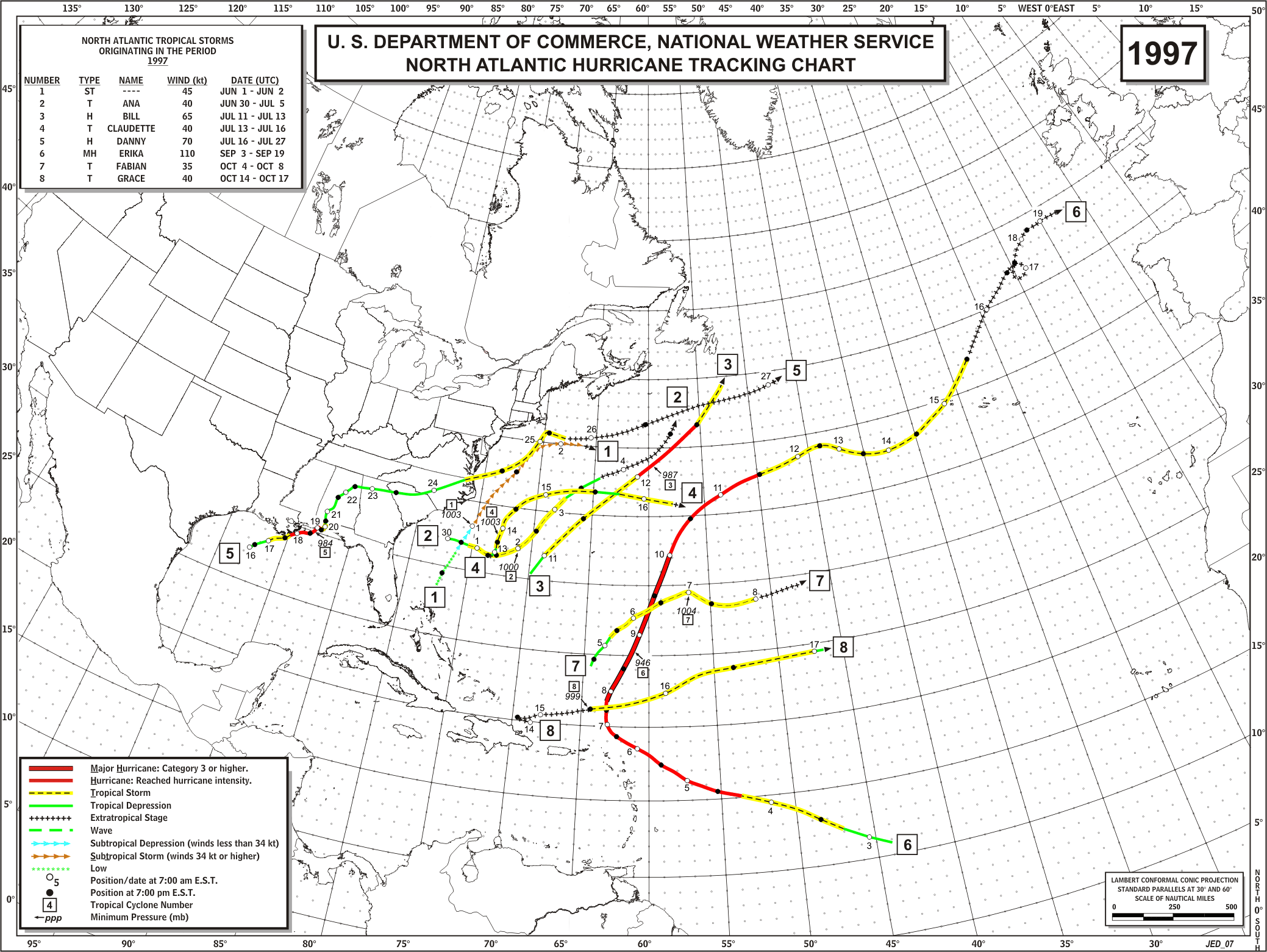
One particularly glaring example of that is 1997. By this date in 1997, we had the fourth named storm of the season -- Danny.

But during the rest saw only three additional named storms, including one hurricane.

That season had a total of seven named storms, including three hurricanes, one major.

2008, 2005, 1997, and ENSO

Recently I wrote about how the tropical atmosphere was angrier at this stage in the season than it usually is, and this was reminiscent of 2005, but we were already falling behind that year's record pace. I included data from Dr. Phil Klotzbach, which indicated that years with early-season stats rivaling those of 2008 went on to have at least one very significant and destructive event.

Then came Dolly, whose initial damage estimates are upwards of $ 3/4 billion.

My colleague Jon Erdman followed with an entry with some other stats; this weekend that data was adapted into this graphic for airing on TWC, to illustrate a couple of extreme cases -- 1997 and 2005 -- in which seasons that got off to an active early start were drastically different thereafter.


Here's some more info about this season, 2005, and 1997.

There have been a number of scientific studies examining the relationship between ENSO (El Nino / Southern Oscillation) and tropical cyclones, showing that El Nino tends to suppress them in the Atlantic basin. But it had been my anecdotal observation that the idea oft-cited by the media and meteorologists that La Nina is a boost to the Atlantic hurricane season was overrated -- that in actuality both La Nina and "neutral" seasons (no El Nino or La Nina) had historically been more active, i.e. it was less that La Nina forced a boost, than El Nino exerted a downward pressure.

(El Nino refers to above-average sea surface temperatures, or SSTs, in the central and eastern equatorial Pacific, La Nina being the opposite.)

So a couple of years ago this week I dug into the data and posted a blog entry about it. Indeed, neutral seasons tend to be active along with La Nina ones; when it comes to El Nino, strong ones have more of an inhibiting influence than weak ones. There have been notable exceptions to all of the above, but what I've described is the case on average based on my informal yet objective look at the data, which I've updated to include through 2007 here.

Speaking of strong El Ninos, In 1997, one of the years featured on the graphic above, there was not only a full-fledged El Nino in progress by this date, it was the strongest on record for the Jun-Jul-Aug period. That El Nino continued to intensify rapidly, and at the peak of the hurricane season (Aug-Sep-Oct), no other El Nino in the historical record at that time of year even comes close to 1997's strength.

Currently in the equatorial Pacific, there are mixed signals, with a pattern in the atmosphere more typical of neutral conditions or even a lingering La Nina, and water temperatures still below average in the central Pacific, but the eastern Pacific looking like a developing El Nino (and water underneath the surface in the central Pacific is getting warmer too). The net effect -- for now -- is a wash (neutral conditions).

Recent years have been a mixed bag, both with the state of El Nino/La Nina and the outcome of the Atlantic hurricane seasons.

At this point in 2004 and 2006, a weak El Nino was developing, and the seasons had drastically different results.

In the extreme season of 2005, a weak El Nino was ending in early summer, and neutral conditions were present during the peak of the season.

In 2007, La Nina developed during the hurricane season. Last year had the dichotomy of a few very intense and/or deadly hurricanes in and around the Caribbean, with mainly weak and/or short-lived tropical and subtropical cyclones elsewhere.

The upshot of all of this: there's no way of knowing exactly what the rest of 2008 will bring, but it's worth noting that in 1997 there was a climate signal of extreme magnitude present. As I've written cynically in the past about El Nino and La Nina, usually one must be careful to not place too much emphasis on those phenomena ... but in 1997 the whopper El Nino was clearly the dominant factor which overwhelmed that season after the early activity in June and July.

Below are the mid-July SST anomalies from NOAA for 2008, 2005, 1997 ... and 1982, when the other most exceptional El Nino of the modern record besides 1997-98 developed. It went on to rival the 1997-98 one in strength during the winter peak, but the way the '97-'98 one came on initially during spring and early summer really stunned the climate science community. On the maps below you can see how 1997 sticks out like a long, red, sore thumb.

Without that sort of thing present, I'd be shocked if 2008 ends up with only 8 storms like in 1997.


Liberal green alarmist!

Yes, I'm a flaming, I mean really flaming, liberal! Like the Miriam-Webster definition, I believe in "individual freedom from restraint and usually based on free competition" and "the self-regulating market"! Oh, wait a minute, that means I'm a conservative! Or am I a libertarian! I don't know! I'm so confused! But what I do know is that I want to crush the existence of capitalism! I want to make sure nobody emits one iota of carbon dioxide EVAR [sic] again! I want to destroy businesses! And pass laws to ban people from driving the vehicle of their choice! In fact, I think the government should forcibly remove all SUVs from people and destroy them! And there shouldn't be any factories! Or, for that matter, cities! That's because I'm green! I'm so green, I'm fluorescent! No, make that neon! And worst of all, I'm an ... oh my goodness, I don't know if I can bring myself to say it! Deep breath! And since this is a family-oriented website, if you're under 18, or offended by dirty words, please close your browser now, because I -- I can't say it, so I'll spell it: I'm an A-L-A-R-M-I-S-T! And to that end I was caught in believing the bogus bunkum balderdash scam crock that Arctic sea ice is on a long-term trend of decline, including in the month of May! Or was that Northern Hemisphere sea ice -- I don't know the difference! I'm so confused! And I didn't realize that my colleague Greg Forbes authored an article on the history of environmental hysteria! And all this when "50,000 physicists" of the American Physical Society have "rejected the AGW [anthropogenic global warming] doctrine!" And this paragraph is a tribute to the late great rock'n'roll critic Lester Bangs who once wrote a review with every sentence ending with an exclamation point!

Well, the Lester Bangs part is true.

As for the rest of it?


It's been an interesting few weeks in blogland. I get back from La Jolla and post a blog entry. It mentions that the presentation I gave there was part of a climate-related program, but otherwise doesn't say a word about that topic and instead immediately moves on to describe the weather conditions I observed en route.

What happens? I get flamed about being a "liberal" who wants to "wreck our economy and people's lives."

In a post on TWC's Forecast Earth website, climate.weather.com, my colleague Buzz Bernard laments the reaction I received and the use of perjorative language toward me.

Then things get really interesting.

He, of course gets quite a reaction himself, which was expected. But it doesn't stop there. The off-topic reaction to my weather entries continues and increases, culminating in this incineration followed by this one and this one and this one and this one and others, all in response to entries about Hurricane Bertha and Hurricane Dolly that didn't include one word about global warming.

Hmmm. Watt's, er, what's up with that?

Did The Weather Channel blog get trolled?

Given the similarity in style and content of many of the comments, was much of this the work of one person or a small number of people?

Regardless, the essence of what was expressed represents the sentiment of more than just those who recently posted comments here, especially given the current economic realities. So it's worth making a few points for those who may be new readers of TWC's blogs and are wondering what my views actually are, and because this represents a broader set of issues which go way beyond The Weather Channel blog.

In addition to the Forecast Earth climate blog, I'm posting this on the weather blog since that's where most of the reaction occurred. Moving forward we ask that people be respectful of weather enthusiasts (labeled "weather dweebs" in some comments) who frequent the weather blog and be aware of TWC's guidelines about comments which are off-topic, etc., that TWC will henceforth enforce.

I do not post my blog entries anonymously or with a pseudonym, and everything I've written remains on the websites. So as to save people the effort of having to search, here are excerpts of what I have written on stuff which is pertinent to the discussion at hand.

Posted on February 2, 2007, the day that the IPCC's Fourth Assessment Report was first released:


>>>>
This is where the distinction needs to be made clear. I (and TWC as an organization) understand that science and policy/politics are inextricably linked, and in particular with regard to climate change there are very difficult political and economic issues to wrestle with in terms of how far to go with passing laws to curb greenhouse gas emissions ... but when it comes to the science of global warming itself, PHYSICS, CHEMISTRY, AND THERMODYNAMICS ARE NEITHER LIBERAL NOR CONSERVATIVE.

Nevertheless, you may be inclined to make some assumptions about my politics and figure I'm just trying to shift attention away from that. Well ...

For whom did I cast ballots during the most recent election in Georgia, where I live? Did I vote for Democrats? Yep.

And I voted for (gasp!) Libertarians.

And (shock!) Republicans.

In every election I evaluate every candidate in every race from the local level on up and vote for whoever would represent the best choice in each case.

Even President Bush, who is not exactly considered left-wing, referred to the "serious challenge of global climate change" in his State of the Union Address last week.

...

Often negative references are made to "alarmists," even by those who think that humans are primarily responsible for global warming. You'll get no argument from me that blaming global warming for every conceivable problem is not productive (we have a lot of things to worry about, but the Earth exploding does not seem to be one of the more urgent ones ...).

The definition of alarmism implies needless warnings, but there is a legitimate threat on many levels, based on current observations (in the atmosphere and oceans and on land) and the effects already being experienced by humans and ecosystems in parts of the world, as well as what's gone on in history with civilizations that have met their demise at least partially due to changes in climate.

"Medical Metaphors" by Richard Somerville, one of the top climate change experts in the world, is one of the best pieces on the subject and I highly recommend reading it.

That essay and its medical analogy have particular meaning to me. I've known too many people in the past few months who have been diagnosed with very serious diseases that started out with symptoms appearing to be relatively innocuous, to not have that weighing heavily on my mind when it comes to the health of the planet.

TENANTS

Living in harmony with the Earth is our moral responsibility, of which dealing with anthropogenic climate change is just one component.

That doesn't mean no cities or industry or machines or pollution, it means striking a reasonable BALANCE (a key word that can apply to a lot of things in life) as society wrestles with the question of how much to limit emissions of carbon dioxide etc. This applies not to just greenhouse gases but to all the junk going into the air and water and onto the land.

Even if I haven't moved anyone an inch with respect to global warming (for some it'll take temperatures in the 140s, as depicted in this satire!), and regardless of one's political proclivities, it's important to not lose track of this: WE ARE TENANTS ON THIS PLANET, NOT ITS OWNERS.
>>>>


And, earlier this year:


>>>>
... the political and economic realities involved with deciding how far to go in forcing the issue of mitigation are difficult ones, while there is no question that the need to adapt is a given. Regardless of what happens in future centuries, we have the next 50 years and 20 years and decade and year and tomorrow to deal with. And it's not a question of which climate, a relatively cold or warm one, is "better," it's the rapidity of change which is problematic for human civilization (and the animal and plant worlds), as well as vulnerability to weather and climate phenomena such as floods, droughts, temperature extremes, and intense cyclones (tropical or otherwise). That's the case regardless of global warming, and a shift to a more volatile weather/climate regime would exacerbate the situation.

Although Roger Pielke Jr.'s points of view and mine may not always be identical, when I go back and read his paper on adaptation from 10 years ago, I'm hard-pressed to find anything in there I disagree with.
>>>>


Yet we've gotten to the point where just because someone (and there are many besides me) is concerned about the state of the climate and the planet, labels such as "alarmist" and "green" and "liberal" are hurled in a derogatory manner, even to the point of them being used as nasty epithets. (An irony being the relationship of the words "conservative" and "conservation," but I digress.)

Another irony is that not only do I not have a history of being "alarmist," I have been so skeptical in the past that a piece I once co-authored was cited in an article by one of the most prominent global warming skeptics.

So in regard to the accuracy of the recent comments, caveat lector.

That applies not only in regard to their invectives about me personally, but with their specific claims on the "global warming is a hoax" front.


50,000 PHYSICISTS

First, let's put to rest once and for all the claim that "50,000 physicists" of the American Physical Society have "rejected the AGW doctrine!"

Not.

From the APS website:

"APS is reaffirming its policy on global warming because an article at odds with the official APS position recently appeared in an online newsletter of the APS Forum on Physics and Society, one of 39 units of APS.

"Online reports erroneously implied an APS policy change. These reports did not include the disclaimer, 'Opinions expressed are those of the authors alone and do not necessarily reflect the views of the APS or of the Forum,' which was attached to the newsletter article."

The APS organizational position on climate change is here.

(And, as for the article itself which got posted on the APS site and caused all the fuss, see this recent rebuttal.)


MAY 1980 = MAY 2008


[Source: National Snow and Ice Data Center (NSIDC); click on image for larger version.]


Then there were the folks who pointed me to this website, which features the graphic above, showing that Northern Hemisphere sea ice concentrations in May 1980 and May 2008 were the same, at 10.9 million square kilometers.

States the website, "After 28 years of warming Arctic sea today is where it was when measurements started. Where is the media now that the Arctic ice concentration is at the same concentration as when measurements began 28 years ago?

Not.

The problem was the "pole hole." Hold your laughter, please -- there is such a term in satellite technology, and it's important in this case. In fact, in that graphic you can see the holes in the data, and their different sizes, at the North Pole.

Sea ice concentration area numbers from 1980 and 2008 can't be compared because the region imaged by the satellite is not the same. Satellites such as these can have a data void near the poles; a new satellite began being used in 1987, and although the two satellites have similar characteristics and consistent data, given the different size of the pole holes the comparison of 10.9 million sq km to 10.9 million sq km is not apples-to-apples. Comparing the sea ice extent or the concentration anomalies shows May 2008 being nearly a million sq km lower than May 1980.

I asked the folks at the National Snow and Ice Data Center to provide an in-depth explanation of the pole holes and their ramifications for data comparison and sea ice concentration vs. sea ice extent, which they did, and I've put it here.

Eventually, the website, to its credit, printed a correction as part of an "important update," but not before the original claim had been seized upon by some TWC blog readers.


GREG FORBES

And, finally, there was the person who admonished, "Please take a look at this article on the history of environmental hysteria co-authored by Greg Forbes." The comment provides this URL, which is an article that refers to the paper "Hysteria's History: Environmental Alarmism in Context," which indeed is co-authored by Greg Forbes, the implication of the blog comment being that it's TWC's severe weather expert.

Not.


My TWC colleague, the esteemed scientist who was an understudy of Dr. Ted Fujita, has written some things about climate change, but here on The Weather Channel blog, discussing, as I have in the past, tornado climatology in the context of global warming and the increase in off-season twisters.

Wasn't, however, that article about climate alarmism cited by the reader co-authored by Greg Forbes?

Yes, by Greg *R.* Forbes.

The severe weather expert at The Weather Channel is Greg *S.* Forbes.

Oops.


I wonder what Lester Bangs would have to say about all this if he were in my position. Maybe, "Rock on, weather dweebs and liberal green alarmists!"

T Minus One Week and Counting

Feel that chill in the air friends? That can mean only one thing. The Weather Channel Half Marathon (and let's not forget about Thanksgiving Day) is about a week away!

What a wild and crazy ride this has been. It's only been about 6 months since I went out for my first run (and I really do mean ... my FIRST run.) I found about this challenge back in March, so I dragged my feet long enough by waiting until May. I guess I fell back into my college procrastination ways and waited until I realized this whole half marathon thing was REALLY happening and that I didn't want to be completely embarrassed on national television.

So here we go, I've got my running shorts (and in case you haven't noticed, I'm kind of a jeans guy even when its 120 plus degrees in Death Valley, call me crazy so the short thing in of itself took some getting used to). I've got my running shoes and its go time! So I hit this trail by The Weather Channel offices. It's a very scenic and lovely -- and most importantly flat, so I stretch like I've seen on those am morning workout shows and then I'm off. Lucky for me there are markers on the side of the trail clicking off mileage ... you know ... .25, .50, .75, 1 mile so I can track my out the gate progress. Now I realize I'm not man/womankind's gift to physical prowess but I figured even I could bang out a mile without too much difficulty, I mean high school gym class wasn't THAT long ago was it? Well let me tell you something, apparently high school gym class WAS that long ago as I was sputtering along after about a half mile wondering seriously for the first time what on earth I had gotten myself into. I figured it was only a matter of time before police dogs found me on the side of the trail and I ended up on an episode of some forensic style police show. Long story short ... Thanksgiving day was CLEARLY not far enough away!

(Fast forward 6 months)

That was then, this is now and while I'm not ready to call myself a professional runner just yet it's truly amazing what a little determination and lack of wanting to be embarrassed will get you when you put your mind to it. I can't tell you how thankful I am that The Weather Channel decided to sponsor this year's half marathon down Atlanta's most famous street (Peachtree). Because it gave me the kick in the pants I've needed for years and I hope this challenge may have even helped you out a little bit in that department as well!

Over the past 6 months I've run on the scenic beaches of Nantucket, through the oxygen light Rocky Mountains and even over the burning sand of Death Valley (where the temperature topped out at just over 120 degrees thank you very much). Each of these locations and climates provided their own unique challenges and I've met runners from all over the country who helped me to get ready to achieve my goal of finishing my first half marathon. You can check out some of the video online, but I found it incredibly interesting to hear and see first hand how these runners deal with the different situations Mother Nature throws at them throughout the year.

So, it's been an adventure -- I hope some of you have been enjoying the programming surrounding the marathon. It's not over yet, I still have to actually finish the 13.1 miles followed by a guilt free Thanksgiving feast unlike any the world has ever seen! Check back here in about two weeks and I'll let you know how everything turned out, but come heck or high water I'll be crawling over that finish line and I wish the best of luck to any of you who will be joining me for the finish of this wild ride!

Deadly Nocturnal Tornadoes; Secondary Cold Front

DEADLY NOCTURNAL TORNADOES

A pair of tornadoes each caused a death in the wee hours of the morning on Saturday November 15 in North Carolina. This brought the death toll for the year to 125. You have to go back to 1998 to find a deadlier year (130 tornado deaths), and then all the way back to 1974 (366 deaths).

The killer tornadoes also continued a trend for November -- deadly nocturnal tornadoes. 87% of the tornado deaths in November in the last 15 years have been at night. Nocturnal tornadoes tend to be deadlier than ones in the daytime at any time of year, with 42% of all tornadoes occurring at night, but causing 57% of deaths in the 1997-2006 period. People are often asleep and can't normally see the tornado coming. And residences are often of weaker construction than the buildings where many people work during the day.

Stu Ostro wrote a blog on November 15 showing the radar from the deadly EF2 Kenly, North Carolina tornado that struck shortly after 3AM on Saturday morning, November 15. The second killer tornado that night struck about a half hour later, an EF3 just west-southwest of Elm City, NC. Its radar precipitation pattern is shown below.

The tornado is on the southeast edge of that band of red, just west-southwest of Elm City. Notice the overall S-shape of the precipitation pattern, sometimes called a LEWP (line-echo-wave-pattern) known to sometimes be conducive to tornadoes. The storm-relative velocity pattern below shows a red-green couplet inside the circle that I've superimposed. This is the tornado signature, with red indicating eastward and green indicating westward. "Storm-relative" means that the storm motion has been subtracted. This often accentuates embedded rotation signatures like this one, making then easier to spot and warn on.

Following this event, a series of cold fronts have made it too cold and stable across the United States for severe thunderstorm and tornado activity. The image below shows one of those cold fronts, from Friday November 21.

SECONDARY COLD FRONT

This visible satellite image shows what we sometimes call a "secondary" cold front.
It is a "reinforcing" cold front, bringing in even colder air into an area that was already cool. I've drawn a yellow arrow to indicate the location of the secondary front -- that band of bright clouds running basically from west to east.

The orientation of my yellow arrow indicates winds from the north-northeast and bands of clouds called "cloud streets" in the cooling air behind the front. The cloud streets are formed as the cold air is heated and moistened over the warm Gulf of Mexico behind the front. Brighter, taller clouds at the arrowhead are enhanced by the convergence in the colliding air masses right at the front. Other bands of clouds south of the cold front may be remnants of previous fronts that moved into the area and weakened.

This secondary front is already showing such signs of weakening on the surface weather map below. I've drawn blue and red arrows to indicate the winds behind and ahead of the front. The relatively small wind shift suggests a weakening front, not atypical of secondary fronts that have gone this far south (away from their Canadian cold air origin.

The cold air behind this front promises to keep conditions too stable for a tornado threat through at least Sunday.